Siberian Goose Down - Marketing Genius, or Deception?
I am often asked about our goose down, how it is harvested, cleaned, etc. All good questions from smart conscientious shoppers. Sometimes during the course of this conversation I'm asked "What about Siberian Goose Down?" That's an interesting question.
There is no such thing as Siberian Goose Down. In other words, Siberia is not and has never been a commercial point of origin for goose down. Siberian Goose Down, or as the name implies, goose down that comes from Siberia or the Siberian Goose, is essentially a myth.
So, What is Siberian Goose Down?
Most of the worlds goose down comes from China. A much smaller amount (relatively speaking) of goose down originates from Europe, mainly from Poland and Hungary. An even smaller amount of goose down comes from the United States and Canada.
This European and North American down is generally considered to be of superior quality, mostly due to the harvesting, sorting, quality standards and sanitizing procedures which are very highly regulated compared to the relatively unregulated practices in China.
A major supplier of "Siberian Goose Down" states: "We have marketed and sold a high end, expensive, European region product called `Siberian Goose Down' for a couple of years or more in this country and world wide. We have never claimed this product to represent a single country of origin".
So. Hungarian goose down comes from Hungary, Polish goose down comes from Poland, Canadian Goose Down comes from Canada, but Siberian goose down apparently comes from everywhere in Europe, or nowhere, depending on how you look at it.
Siberian Goose Down is a made-up name, a product of a clever marketer's imagination. As meaningful as something like "Platinum Goose Down". Unfortunately, this product can be of any quality, high or low, and can come from anywhere, and does; mostly from China and Europe.
Retailers and manufacturers, perhaps innocently, seem to perpetuate the myth by claiming that this down is superior because of the extremely cold climate in Siberia. Well, at least they get one thing right. The climate in Siberia is extremely cold, with temperatures down to 100° below zero Fahrenheit. This climate is far too severe to farm geese in. They cannot live there during the winter.
The Siberian Goose
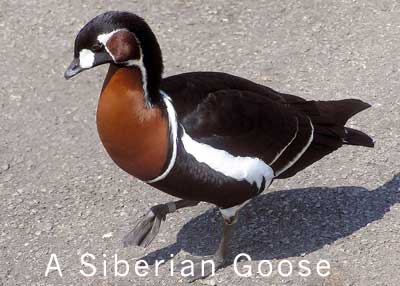
There really is, in fact, a Siberian Goose. It is a migratory wild bird (it leaves Siberia in the winter) and an endangered species protected by international treaty. Incidentally, it's breast plumage (where the down would come from) is red, with the rest of the plumage being predominately black (see image, below). Siberian White Goose Down? Not likely.
There is also a very large population of the migratory White Snow Goose on Wrangle Island, a wildlife preserve north of Siberia. These geese are in residence only during the summer and are protected from harvest. Many of these White Snow Geese winter near our home here in the Skagit valley in Washington State.
The Common Eider Duck, a wild migratory bird that produces Eiderdown, is also known to nest along the coast of Eastern Siberia during the summer.
Siberia has vast supplies of oil and gas, coal, timber, over 1/5's of the worlds fresh water supply, and is home to nomadic tribes that herd reindeer. But no Siberian Goose herders.
The moral of this story? Buyer beware, and do your homework.
More information about Siberian
culture, economics and business | More
about Snow Geese
A Plumeria Bay® Hungarian Goose Down Comforter

Update: The preceding article was written in 2004. In 2008, a major supplier of goose down contacted us to say that a very small quantity of goose down, purportedly from Siberia, had become available on the market by special advance order.
He also noted that this goose down was in no way superior to an average 800 fill white goose down from Hungary, Poland or Canada.
We couldn't help but feel that this supplier's offer to us was perhaps, in some way, inspired by this article. Obviously, we still do not offer any products with "Siberian down".
Our advise would be to take a good hard look at the company that is offering a so called Siberian down comforter or pillow.
My question would be: If they are willing to overlook this misrepresentation, what else are they willing to overlook?
So, we believe that this article is still accurate and relevant and we're proud that we've ruffled more than a few feathers (and hopefully educated a few consumers) since its publication.